Compliance & Security
The 2026 Guide to Secure Document Fulfillment

Outsourcing a mailing means handing a file of personal data to someone else and remaining accountable for what happens to it. Two separate assurance routes govern that handover in Singapore, they cover different things, and a vendor who blurs the line between them is worth a second look. This guide sets out what each route covers, what it does not, and what to ask for where neither reaches.
The two routes, and why the distinction matters
Print and mail work in Singapore is assured either through the banking sector's audit framework or through data protection law, and most vendors sit partly under each.
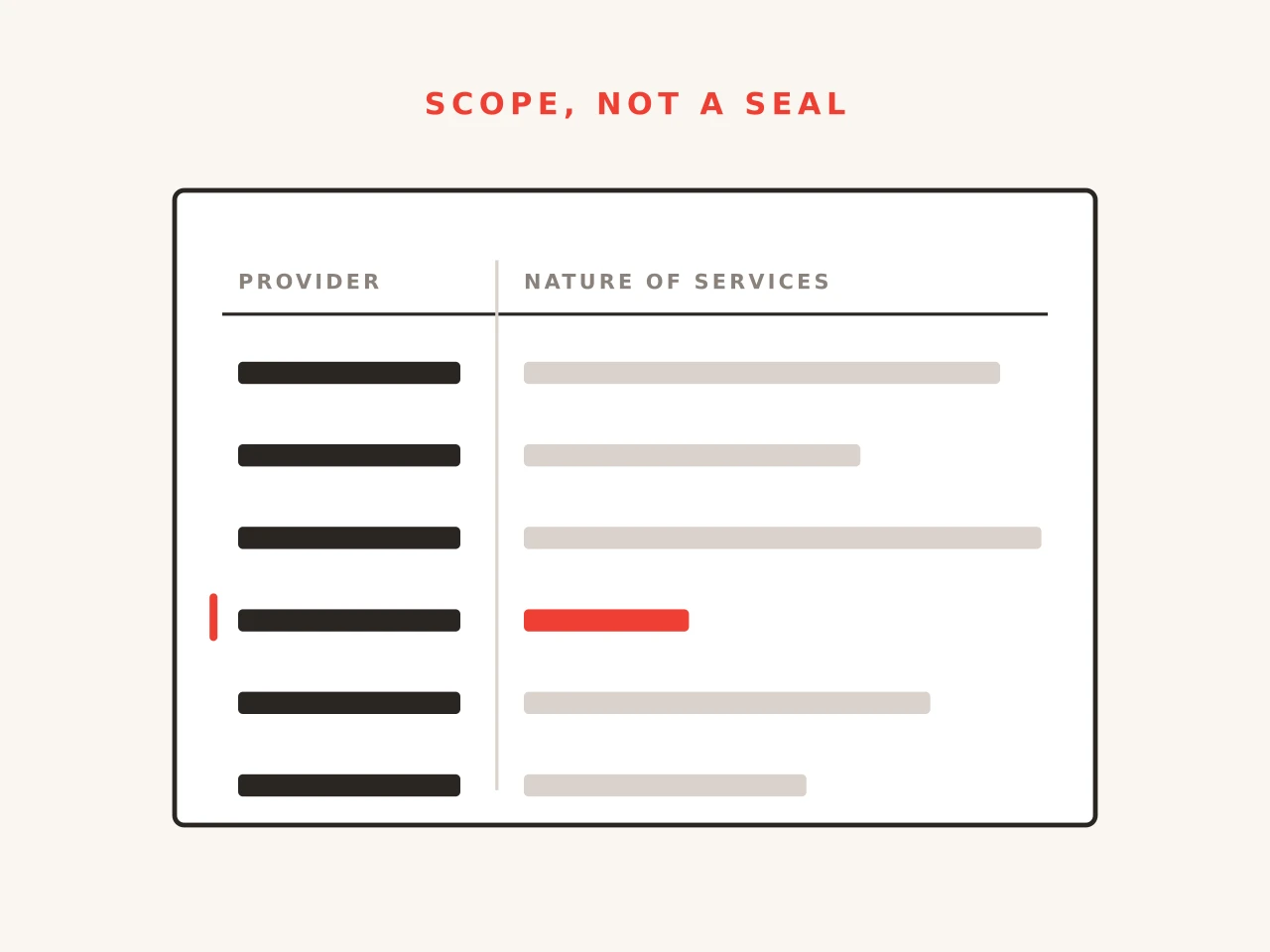
The first route is the ABS framework. The Association of Banks in Singapore publishes guidelines on control objectives for outsourced service providers, and an Outsourced Service Provider's Audit Report is an independent audit against them. It is an audit report, not a certification, and it covers a defined scope of services rather than a company as a whole. We explain the framework plainly on what it means to be OSPAR audited, and how to read the public register of audited providers in our piece on what the register tells a bank.
The second route is the Personal Data Protection Act. A print vendor handling customer records for a client acts as a data intermediary, and the client organisation remains accountable for the personal data throughout. This is the route that governs print-side handling, and it is contractual and statutory rather than audited by a single industry body.
The distinction matters because the scopes rarely line up with what is being bought. Our own audited scope under the ABS OSPAR programme is mailroom, messaging and local courier services. It does not extend to printing or to lettershopping, and we say so rather than letting the listing imply otherwise. Print-side data handling is answerable under the PDPA instead.
The data lifecycle, and the three points to ask about
For print-side work, three control points cover most of the risk, and each should be answerable in a sentence.
- Transfer. Data should never move by ordinary email. Encrypted transfer over SFTP, with AES-256, keeps the file unreadable to anyone intercepting it in transit.
- Processing. Access to a live customer file should be restricted to the people running the job, for the duration of the job.
- Purge. Retention is a liability, not a service. Data should be removed after production rather than held indefinitely, and a vendor should be able to state when that happens and how.
Ask for these three as specifics rather than as assurances. A vendor who can say what happens to your file, in what order, and when it stops existing on their systems is describing a process. One who answers with adjectives is describing a brochure.
Recipient matching is the control that prevents the worst failure
The characteristic disaster in mail production is not a breach of the file. It is one recipient receiving another recipient's document.
This is worth stating plainly because it is the failure mode that produces a reportable incident from an otherwise clean job. The control is verification at the point of insertion: a barcode on the letter matched against the envelope and checked before sealing, so that a mismatch stops the pack rather than sending it. The important property is what happens on failure. A system that flags a mismatch after sealing has recorded a problem; one that halts before sealing has prevented it.
A related check belongs to the same category. Where an envelope has a window, the position of personal identifiers on the page determines what is visible from outside, so the alignment between page layout and window is a privacy control rather than a print-quality one. We break the matching control down further in our piece on data security in physical mail.
Where the sensitive part of the work actually sits
Most attention goes to the digital handover, and most of the residual risk sits in the physical stages after it.
Once a file is printed, the controls that matter are physical: who can enter the production area, what happens to spoiled or misprinted sheets, and whether the count leaving the floor reconciles with the count that was meant to be produced. Setup waste from a variable-data run carries real customer data and has to be destroyed rather than discarded.
These are also the controls an assurance engagement is built to examine. An audit of this kind samples evidence across a period rather than testing capability on the day, so a control that exists as a written procedure but is applied inconsistently produces no usable evidence trail. Consistency, not capability, is what gets tested.
What to ask for before you sign
Ask for scope in writing, and ask separately about everything outside it.
Where a vendor holds an OSPAR, ask for the nature-of-services wording exactly as it appears on the ABS register, and check it against the work you are actually placing. Where the work falls outside that scope, ask which PDPA controls apply and how each is evidenced: how the file arrives, who can open it, when it is purged, how recipient matching is verified, and what the reconciliation record looks like at the end of a run. Those answers belong in the outsourcing paperwork rather than in a conversation.
A vendor who draws the line clearly between what has been independently audited and what is governed by contract and statute is easier to place on your own risk register than one whose assurances cover everything equally. The controls we apply on the print side are set out under secure data printing.
Updated 6 August 2026 to state our OSPAR scope precisely, to remove facility descriptions that were not verifiable, and to separate the ABS and PDPA assurance routes.
Tags