Compliance & Security
Sending an Address File Into Singapore: Which Way the Rules Point
An overseas brand planning a Singapore mailing is usually told that the Personal Data Protection Act governs the address file it is about to send. It does, but not in the way most briefing notes describe. The Transfer Limitation Obligation runs in one direction only, and it is not the direction the file is travelling.
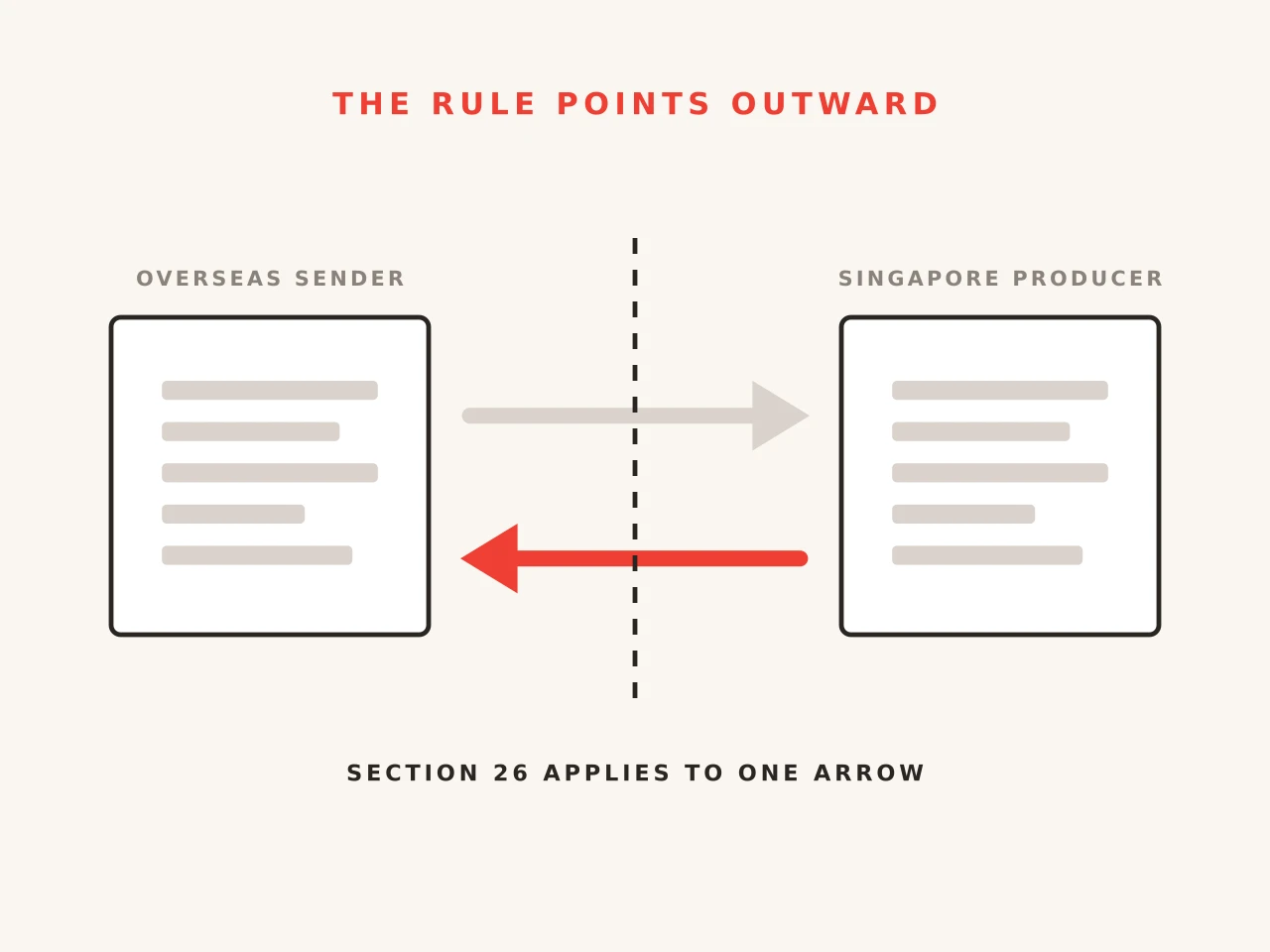
Section 26 limits data leaving Singapore
PDPC's own guidance is directional throughout. Paragraph 19.1 of the Advisory Guidelines on Key Concepts in the PDPA, revised 29 April 2026, states that "Section 26 of the PDPA limits the ability of organisations to transfer personal data to another organisation outside Singapore in circumstances where it relinquishes possession or direct control over the personal data". Paragraph 19.3 restates the section itself: an organisation "must not transfer any personal data to a country or territory outside Singapore except in accordance with requirements prescribed under the PDPA".
Paragraph 19.2 explains why it runs that way. Where an organisation discloses personal data to its data intermediary and both are in Singapore, the intermediary "is subject to the Protection, Retention Limitation and Data Breach Notification Obligations for the personal data that it thereby receives". It is the transfer to an organisation outside Singapore that needs a mechanism, because at that point "the recipient organisation is not subject to the PDPA".
There is no inbound limb. A marketing team in London or New York sending an address file to a Singapore print and mail partner is not constrained by section 26 when it does so, and the vendor receiving it is already inside the Act without one. That is worth correcting, because the usual framing sends people looking for the wrong document.
For an EEA sender the harder constraint is at the other end
The real question on the inbound leg is the sender's own law, and for a European headquarters the answer is less comfortable than for a Japanese or Korean one. The European Commission's published list of countries and territories recognised as providing adequate protection reads, verbatim: "Andorra, Argentina, Brazil, Canada (commercial organisations), Faroe Islands, Guernsey, Israel, Isle of Man, Japan, Jersey, New Zealand, Republic of Korea, Switzerland, the United Kingdom under the GDPR and the LED, the United States (commercial organisations participating in the EU-US Data Privacy Framework), Uruguay, and the European Patent Organisation".
Singapore is not on that list. Japan and the Republic of Korea are, which is the detail that catches teams out: a mailing into Tokyo run under an adequacy decision is not a precedent for the same file coming here. In practice an EEA controller sending personal data to a Singapore vendor puts an Article 46 transfer tool in place, usually the Standard Contractual Clauses, with the assessment that goes with them. That is standard practice rather than something the Commission states in the list, and it is the sender's obligation rather than the vendor's.
The consequence is a scheduling one. The safeguard has to exist before the file moves, and getting it executed inside a brand's own legal function is often the longest single item in a campaign timeline. It belongs at the start of the plan, not the week before the mailing date.
Once the file lands here, the producer is bound in its own right
A Singapore print and mail vendor processing that file is a data intermediary under the PDPA. PDPC says so directly in its Guide to Printing Processes for Organisations: "As they handle personal data in the process of printing, print vendors are considered Data Intermediaries." That carries the Protection and Retention Obligations, in the vendor's own name, independent of anything in the contract.
The overseas brand does not step outside the Act either. The same PDPC guidelines record that the PDPA defines an organisation as "any individual, company, association or body of persons, corporate or unincorporated whether or not formed or recognised under the law of Singapore; or resident, or having an office or a place of business, in Singapore". Being headquartered elsewhere is not a position outside the Act; it is one of the situations the definition was written to cover.
The return leg is a transfer out, and the Singapore party makes it
Every addressed mailing generates a file going the other way: undeliverables, gone-aways, response cards, a reconciliation report. When that goes from the Singapore producer back to an overseas headquarters, section 26 applies, and the organisation making the transfer is the one in Singapore.
There are two workable answers and they should be chosen in advance. The file goes back under the comparable-protection condition, with the contractual terms in place to support it. Or it does not go back at all, and what returns is a count and a corrected address list rather than the personal data. Our view is that the second is usually better for a one-off campaign: it removes a transfer rather than papering one, and the brand rarely needs the individual records to act on the result.
Freighting the printed pieces in does not remove the question
Printing at origin and shipping the finished mailers in looks like a way to keep the data at home. It usually is not, because anything addressed and personalised still needs the address file at the lodgement end. It adds a customs question on top of the data one.
Printed matter is not dutiable here. Singapore Customs lists the dutiable goods as intoxicating liquors, tobacco products, motor vehicles and petroleum products, and says of everything else that "All other goods are non-dutiable and incur GST only". GST is the part worth reading closely, because of the basis it is charged on: "Prevailing GST is levied on the Cost, Insurance, Freight (CIF) value, which includes duties (if dutiable) and all costs incidental to the sale and delivery of the goods into Singapore." Freight and insurance sit inside the taxable value, so shipping the pieces in is not simply an added cost, it is an added cost that is itself taxed. Whether any of that import GST can be recovered depends on GST registration and on who is named as importer, which is a question for the brand's tax adviser rather than its mail vendor.
Then there is the part that cannot be undone. A crate of finished mailers cannot be corrected. A wrong salutation, an address field that a spreadsheet stripped the leading zero from, a unit number that landed in the wrong column: produced locally these are caught at proof or at data preparation, and produced offshore they are caught by the recipient. Address files arriving from overseas systems are where we see this most often, because Singapore postal codes are six digits and a good many of them begin with zero.
Lodgement is local either way. SingPost's bulk mail service sets a minimum of 1,500 items per posting for domestic bulk, and the format decides which rate band a piece falls into, a question we set out in where a Singapore postage bill actually comes down. Deciding the format against the local bands while the artwork can still change is worth more than the discount waiting at the end.
What to settle before the file moves
Four points, in writing, before anything is sent. Which party is making which transfer, and under what mechanism, on both legs. What the Singapore producer will hold, for how long, and what the purge confirmation will say. Whether the returns come back as records or as counts. Whether the format has been checked against the Singapore rate bands rather than the sender's own postal geometry.
None of that is difficult, and all of it is slow if it starts late. Our handling of inbound files is set out under secure data printing, and the production side of an addressed run under lettershopping.
Regulatory positions stated here are current at the date of publication. The adequacy list was read from the European Commission's published page on 16 September 2026, and adequacy decisions change; check it again before planning a transfer on the strength of it.
Tags