Mail Fulfillment Services Singapore

    Lettershopping: Personalised Mail, Matched and Verified

    The end-to-end production of personalised mail: variable-data printing, folding, insertion and sealing, handled as one controlled process with the letter matched to its envelope before the pack closes.

    Get a quote

    Tell us about your mailing

    Volume, format and the date it needs to land. We come back with an all-in cost within a few business hours.

    By submitting this form you consent to In-Touch Singapore Pte Ltd collecting and using your personal data for the purpose of responding to your enquiry, in accordance with Singapore's Personal Data Protection Act (PDPA).

    What is lettershopping?

    Lettershopping, also written as letter shopping, is the outsourced production of personalised mail: merging a customer data file, printing variable content, matching each document to its own envelope, sealing the pack and lodging it with the post. In-TouchSG has run lettershopping lines in Singapore since 1993.

    A lettershopping run moves through five stages:

    1. Data preparation — cleaning, de-duplicating and sorting the recipient file.
    2. Variable-data printing — every piece printed with its own name, figures and offer.
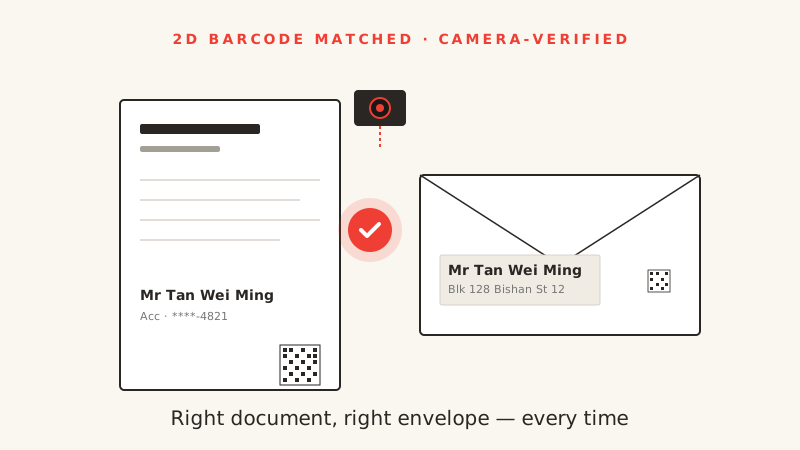
    3. Barcode-matched insertion — a 2D barcode pairs each document with its envelope, checked before the pack seals.
    4. Finishing — addressing, sealing and franking printed direct to the envelope rather than applied as labels.
    5. Sorting and lodgement — pre-sorted into postal sectors and handed to SingPost.

    What separates lettershopping from ordinary print work is the data. Plain printing makes a thousand identical envelopes; lettershopping makes a thousand envelopes that each carry a different document, matched to its recipient and checked before the pack seals.

    Barcode-Matched Insertion

    Every page carries a 2D barcode read by an inline scanner and matched against the envelope before sealing. What matters is the behaviour on failure: a mismatch halts the line rather than being sealed and lodged, because once a wrong document goes out the disclosure has already happened.

    Selective Insertion

    The contents of each envelope can vary by recipient — different inserts, different offers, different language versions — driven by your data file rather than by separate production runs.

    Automated Assembly

    Short runs go through the same automated line and the same verification as longer ones. Low-volume, deadline-bound mail is where hand-finishing usually creeps in, and it is exactly the work that most needs the machine check rather than the least.

    Transactional and Marketing Mail

    The same line handles marketing campaigns and regulated transactional mail such as statements, notices and policy documents. The difference is not the equipment but the evidence: transactional work carries reconciliation and despatch records that a campaign usually does not need.

    Direct-to-Envelope Addressing

    Addresses, personalisation and barcodes are printed inline rather than applied as stick-on labels. Printed directly, they cannot peel in transit and they stay machine-readable for automated downstream sorting.

    What decides the cost of a mailing

    Postage usually outweighs print at any volume, and which rate a mailpiece attracts is set during production rather than at lodgement. Format, fold and insert count are all fixed before anything reaches the carrier, which is why the format specification is worth deciding deliberately rather than inheriting from the design.

    Anatomy of a mailpack

    Eight parts of a precision-built mailpack

    Tap any number to see what it does and why it matters. Four points sit on the envelope and four on the tri-folded letter inside.

    In-Touch Singapore41 Kallang PlaceSingapore 339169SINGAPOREPOSTAGE PAIDPERMIT 0001Mr Tan Wei MingBlk 128 Bishan Street 12#08-214Singapore 570128DL ENVELOPE — FRONT VIEWFOLD ↓FOLD ↑Z-FOLD PROFILEMr Tan Wei MingBlk 128 Bishan Street 12#08-214Singapore 570128TRI-FOLDED LETTER (INSERT)12345678

    Anatomy · Part 1 of 8 · Envelope

    Sender block

    Pre-printed return address and any brand mark. Lets undeliverable items return to sender — and signals the brand before the envelope is opened.

    See the difference

    Three ways lettershopping beats manual mail

    Drag the divider on each example to compare a manual approach with the lettershopping line.

    Random pile of envelopes ready for lodgementEnvelopes pre-sorted into Singapore postal sector stacks
    ManualPre-sorted
    Pre-sorting. Sorting by National Postal Sector before handover removes work the carrier would otherwise do, which is what qualifies a run for SingPost Workshare discount bands.
    Wrong document inserted into the wrong envelope2D barcode-matched insertion verified by inline scanner
    ManualBarcode-matched
    Barcode-matched insertion. Every page carries a 2D barcode read by inline scanners. If document A doesn't pair with envelope A, the line halts before the piece is sealed.
    Adhesive label peeling at the cornerHigh-resolution inkjet address printed direct on the envelope
    LabelInkjet
    Direct-to-envelope addressing. Inkjet printed straight onto the envelope replaces stick-on labels, so nothing peels in transit and the address stays machine-readable for automated downstream sorting by SingPost.

    Hover any underlined term on this page for a quick definition. Common terms include VDP, OMR, PURL and phygital.

    Common questions

    Lettershopping — frequently asked

    Lettershopping — also written as letter shopping — is the end-to-end production of personalised mail: variable-data printing, folding, insertion and sealing, handled as one controlled process rather than as separate steps. It covers both marketing campaigns and regulated transactional mail such as statements and notices.

    Yes — “letter shopping” and “lettershopping” refer to the same service; the two-word and one-word spellings are used interchangeably across the industry. In-TouchSG has provided letter shopping services in Singapore since 1993, covering data, variable-data printing, barcode-matched insertion, finishing and lodgement under one roof.

    Every page carries a 2D barcode that is read by an inline scanner and matched against the envelope before the pack is sealed. If the letter and the envelope do not pair, the line halts rather than sealing the piece — the control prevents the mismatch instead of recording it afterwards.

    Yes. Short runs go through the same automated line and the same barcode verification as longer ones. Low-volume mail is often the most sensitive — exception mail, statutory notices and deadline-bound correspondence — so it is the work that most needs the machine check rather than hand-finishing.

    Yes. Selective insertion varies the contents of each envelope by recipient — different inserts, different offers, different language versions — driven by your data file rather than by separate production runs.

    Addresses, personalisation and barcodes are printed directly onto the envelope inline rather than applied as stick-on labels. Printed directly, they cannot peel in transit and they stay machine-readable for automated downstream sorting.