A renewal notice posted a month before expiry is already late. Singapore's general insurance code counts the notice period in business days rather than calendar days, which puts the real deadline about six weeks ahead of expiry. Insurance mail runs on clocks like that, and most of them start when the document arrives rather than when it prints.
Thirty business days is closer to six weeks
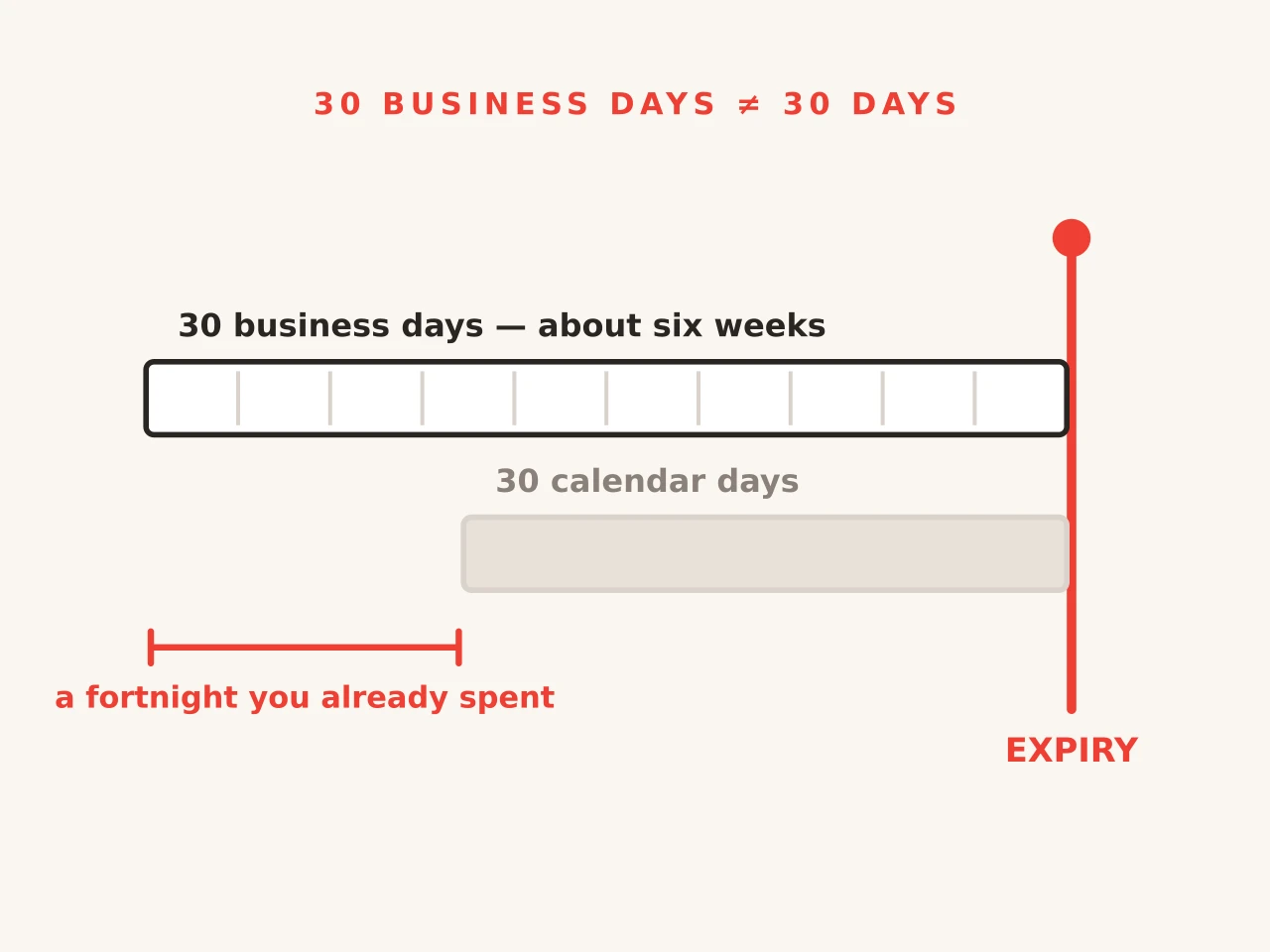
General insurers work to a stricter renewal timetable than the phrase usually suggests. The General Insurance Association's Singapore General Insurance Code of Practice, revised 25 October 2022, sets the standard at clause 5.2 for annually renewable policies: "We will inform you when you need to renew your policy or when the policy will expire, at least 30 business days before expiry, to allow you to consider and arrange continuing cover."
Thirty business days is about six calendar weeks, and longer where public holidays fall inside the window. A renewal mailing scheduled a month out has already missed the standard by roughly a fortnight. Two related standards belong on the same calendar: clause 4.3 despatches policy documents "within 15 business days from the date of confirmation of cover", and the code's service-standards annex allows 7 days for a policy document on renewal.
The code names no channel. It says a policy "can be sent electronically or via hard copy documents". What it fixes is a date, and a date is a production constraint whichever way the document travels.
The clock starts on arrival, not on the print run
Insurance deadlines are anchored to document events, so the gap between the date printed on a letter and the date it reaches someone comes out of the recipient's time rather than the sender's. Singlife's Shield policy contract states the mechanism at clause 7.14: "The notices, cheques and documents are considered delivered 7 days after the date we sent them." The same contract gives a first-time policyholder "21 days from the date you receive your policy" to decide whether to keep it.
Where a response window starts is not uniform, so check your own wording rather than assuming. MoneySense puts the 14-day life free-look period at "from the day you receive the policy documents"; Great Eastern puts its own at "from the date that the policy document is issued", and says it "cannot be extended". The general insurance code sets its free look at 14 business days from receipt, and excludes motor, travel, domestic maid, short-term and renewal business from it altogether.
What a fortnight actually leaves the policyholder
Combine a deemed-delivery clause with a response deadline counted from the letter date and the usable window collapses. The Life Insurance Association's Standards for Distributors on Deterrence of Undesirable Switching of 21 April 2025 prescribe a template letter for a lapsed regular premium policy. It asks the policyholder to "return this letter to us in the self-addressed envelope", then warns: "If we do not hear from you within 2 weeks from the date of this letter, we will assume that you want to continue with the new policy and leave the old policy as lapsed."
Take the letter date as day zero. If the pack is lodged on day four and the notice is deemed delivered seven days after despatch, it arrives on day eleven against a day-fourteen deadline. Three usable days out of a fortnight. That is our own arithmetic, combining one insurer's deemed-delivery clause with a response window drawn from a different document, but the mechanism is real: the date printed on a document and the date it enters the postal network belong in the same conversation.
Two production requirements follow from the same template. The pack needs a reply device matched to its recipient, because a return envelope in the wrong envelope is a mismatch the policyholder discovers rather than the printer. And the letter merges two policy records with different status dates rather than one, so it is a variable-data job before it is a letter. In our experience these are decided when the file format is agreed, not at proofing.
Motor cover still stops by registered letter
One insurance notice has no digital substitute written into it at all. MSIG's MotorMax specimen reads: "We may cancel this policy by giving seven (7) days' notice by registered letter to you at your last known address." The DBS DriveShield specimen carries the sentence word for word, and Sompo's private motor wording says it in the third person.
The policyholder's side runs on paper too: cancellation by the customer takes effect from the date the insurer receives the original Certificate of Insurance back. This is drafting convention rather than statute, and conventions move. As the wordings stand, motor cover stops through physical documents whatever the servicing app does in between, and seven days is a short enough notice period that a day lost in production is a material share of it.
Working backwards from the deadline
Every clock above is set by someone other than the person producing the mail, and none of them can be recovered once missed. Four habits are worth building into the schedule.
- Convert every service standard into calendar dates before you build a production plan. Thirty business days and thirty days are a fortnight apart, and Singapore's public holidays widen the gap further in some months.
- Date the document to the day it will be lodged, not the day it was composed. Where a response window runs from the printed date, every day between the two comes out of the recipient's time.
- Check where each window starts, issue or receipt, in your own contract wording. It varies between insurers and it decides whether a production delay is absorbed or passed on.
- Treat anything that has to come back as a two-way job, with the reply device verified against the recipient rather than counted into the pack.
The other half of this problem is which communications have to go on paper at all, and what record you have to keep of sending them. We work through that in our piece on the paper floor under insurance servicing mail. Where a deadline is fixed and the run is small, the production question is lettershopping accuracy and turnaround rather than unit cost, and the scheduling sits with fulfilment and logistics.
This article describes published industry guidelines and policy wordings for general information and is not legal or compliance advice. Positions cited are current as at 6 August 2026. The day-count worked example is In-Touch's own arithmetic and combines sources as stated.
Tags