Marketing & Engagement
How a Compliant Property Mailer Actually Gets Made
A property mailer usually fails in production, not in strategy. The list was fine and the artwork was approved, and the piece that reached the letterbox still carried the wrong registration number or the wrong insert. This is what happens to a job between approved artwork and letterbox, and where the checks sit.
What lettershopping actually is
Lettershopping is the end-to-end production of personalised mail: variable-data printing, folding, insertion and sealing, handled as one controlled process.
The phrase earns its keep because the alternative is four suppliers and four handoffs. A designer sends a file to a printer, the printer sends flat sheets to a finisher, the finisher sends filled envelopes to whoever lodges them. Every handoff is a point where the right letter can meet the wrong envelope, and nobody at any of the four holds a record that would show it happened.
What the agency hands over
Three things, and the second is the one that usually arrives incomplete.
- The artwork, in the version the Key Executive Officer approved. Under CEA's Practice Guidelines on Ethical Advertising, estate agents must "vet all publicity and advertising materials of their salespersons prior to publication", so the approved version is the only one that may print.
- The data file. Names and addresses for an addressed run, or a distribution area for an unaddressed one. Addressed work also needs the roster of salespersons, because the identification block changes from sender to sender.
- Owner consent for every property advertised. CEA requires prior consent from the owner before advertising any property for sale or rental, in "writing, SMS or any verifiable mode of communication". Where a property has more than one owner, all of them must consent, and each salesperson advertising it needs consent of their own.
The data file is where jobs stall. On any mail programme the address field decays quietly, because it is only exercised when something is posted, while the phone number gets corrected at every contact. A list nobody has mailed in three years will show you how quietly.
What happens to the file
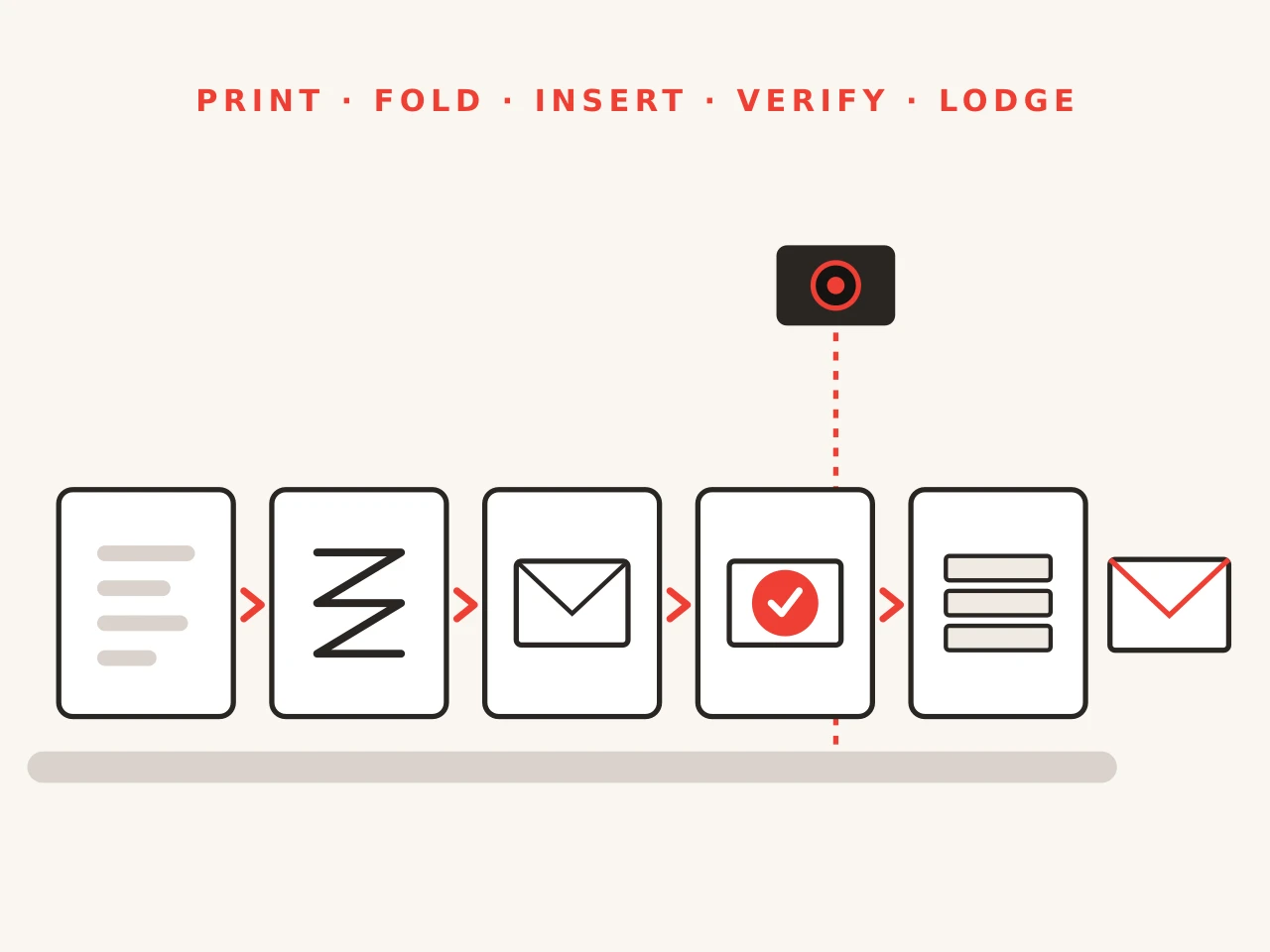
Six steps, in order, and each one has an output the next step depends on.
- Data preparation. Standardise addresses, deduplicate, suppress anything that came back undelivered last time, and map every variable field to its place on the template. This is where the identification block gets populated per salesperson.
- Variable-data print. Text and images change between pieces, driven by the file rather than by a person. On a property run the varying fields include the compliance block and the date of issue, not only the recipient's name.
- Folding, driven by optical marks. Markings printed on the page edge tell the machine which pages belong to which pack, so a four-page pack never gets split across two envelopes.
- Selective insertion. Contents vary per envelope, so one run can carry a different insert for a landed estate than for an HDB block without becoming two jobs.
- Addressing. High-resolution inkjet printed directly onto the envelope rather than an adhesive label, which removes the label-peel failure and looks like correspondence instead of a circular.
- Pre-sort and lodgement. Sorting by National Postal Sector before handover, then the lodgement paperwork with SingPost.
The check that decides whether it went right
Insertion is the step where an error becomes an incident rather than a reprint. The wrong letter in the wrong envelope is a disclosure, and under the PDPA the agency carries it even though the partner made it.
Our answer is a 2D barcode carried on the printed page and read by an inline scanner as the pack is inserted, so the machine confirms that this letter matched this envelope before it sealed. That produces a reconciliation record for the run, which is the thing worth asking for.
There is a second check specific to property work, and it catches a different failure. When the varying field is a registration number rather than a name, a wrong value still looks plausible on a proof. The only control that finds it is reconciling the populated identification block against the source roster, record by record.
What the mailer may say, and what it may not
Most of this sits in the same practice guidelines, and the parts that bite hardest on creative work are easy to miss.
- Every flyer carries the identification block and a date of issue. The five required fields are set out in our piece on the rules behind property mail.
- Transacted properties stay anonymous. Specific floor levels and unit addresses of transacted properties may not be disclosed in an advertisement, and URA REALIS data on individual transacted units is not for marketing use.
- Cite your data. Where publicly available free data is used, "the source of such publicly available data shall be indicated in the advertisement", and the terms of use for that data have to be met.
- Yield claims carry their own disclosure. State any rate of return, yield or capital gain and the advertisement must also state the basis and source, from credible data sources, the definitions of the terms used, and the time period of any past data.
- No guarantees on price. Claims such as a guaranteed Cash Over Valuation, or selling above valuation, are ruled out. So is indicating a preference for any race or religion, except to comply with the Ethnic Integration Policy.
- Advertise real properties only. No dummy advertisements to harvest leads, no copied advertisements, and the material comes down once the property is no longer available or the agency agreement ends.
What to ask a fulfilment partner
Four questions, and the answers should be documents rather than assurances.
- Show me the reconciliation record from a completed run, matching pieces produced to pieces lodged.
- Show me how the identification block is proofed against the source roster, not just against itself.
- Tell me how the data file is transferred, where it is held, and when it is purged after production.
- Tell me what happens to returned mail, and whether the correction goes back to my list or dies in a tray.
If the first two do not exist, the run has no evidence behind it. That is worth knowing before a complaint arrives rather than after, because the four-week clock to answer CEA starts the day it refers the complaint to your KEO.
This article describes published regulatory material for general information and is not legal advice. Positions cited are current as at 4 August 2026.
Tags