Postal Optimization
Two Jobs, One Network: What SingPost's Economics Mean for Your Mail
SingPost's future is usually discussed as a shareholder story: revenue, profit, whether the post office can pay for itself. For anyone who actually sends mail in Singapore the useful question is narrower. What happens to the delivery network your communications depend on, and what should you do about it now?
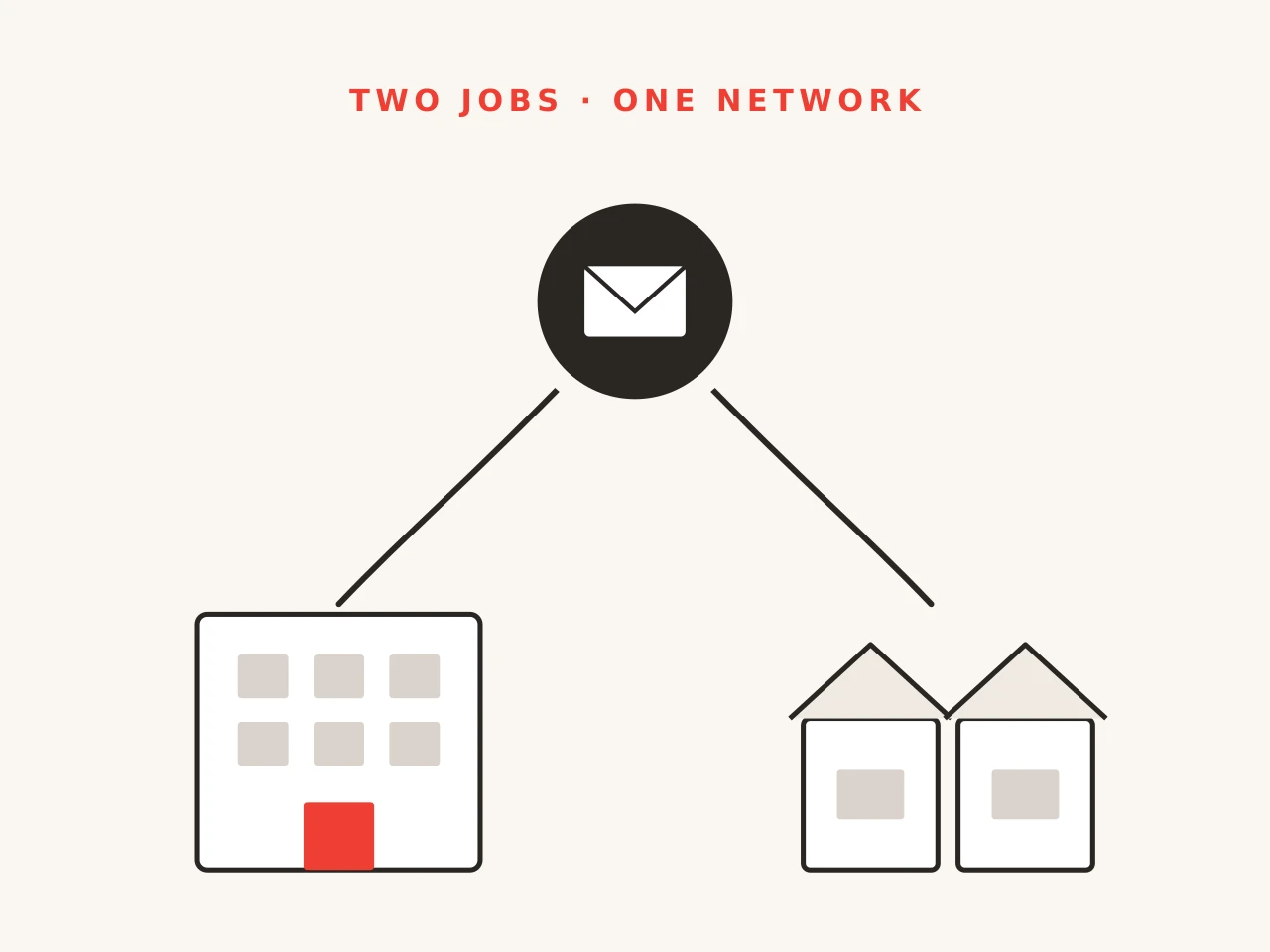
Two jobs that do not fit together
MDDI put the tension plainly in a 2023 parliamentary reply: SingPost "is both a public postal licensee with universal service obligations, and a private listed company".
The licensed duty is specific. Under its Public Postal Licensee licence, SingPost "shall deliver letters that are addressed to any person or premises at a valid address in Singapore", and must "provide and maintain posting boxes and post offices throughout Singapore". The licence was renewed on 1 April 2017 and runs for twenty years, which takes it to 2037.
The first job needs profit. The second does not produce it, and the shortfall widens as volume falls. MDDI put domestic letter volumes at around 490 million in FY2015 against 260 million in FY2022. SingPost says volumes have fallen "by more than 40% since FY2019/2020". That is arithmetic rather than mismanagement, and no postage increase reverses it.
Which changes the question. It stops being how to make the post office profitable and becomes who should pay for universal delivery.
The daily round is infrastructure, not overhead
SingPost reaches every address in Singapore, every day. No commercial courier does, because none carries the obligation. Two things sit underneath that reach which a competitor cannot simply buy: access to every letterbox, and the national postcode system.
That universality is what lets you post an item to any address at a predictable rate and a predictable arrival window, without negotiating coverage first. In delivery economics the cost that dominates is stops per hour. A courier driving to one block for one parcel pays dearly for it. Putting one more item into a bag already being carried costs close to nothing.
Our own view is that the daily round gets mistaken for the cost to be cut. It is better understood as the asset the rest of the system rests on.
Three things worth watching
Postage trajectory. Postage is usually the largest line in a mail budget, and the one line neither you nor your lettershop controls. From 1 January 2026 SingPost raised domestic rates: standard regular mail from 52 to 62 cents, standard large from 80 to 90 cents.
Bulk rates matter more if you mail at volume. Letters at 1,500 units and above went from 48 to 59 cents, around 11 cents, and some grades rose by as much as 32 cents. Since rate rises cannot fix a volume problem, this is unlikely to be the last one.
Delivery-day and transit predictability. Cutting rounds or delivery days is the standard recommendation for any postal operator under this kind of pressure. We are not aware of an announced change in Singapore. If one comes, transit windows widen and get harder to predict. That is an inconvenience for marketing mail and a real problem for anything carrying a statutory or contractual deadline.
Ownership and the discount structure. Bulk discounts are what make pre-sorting worth doing, and they sit with the licensee under IMDA's oversight. SingPost's own shareholding statistics put Singtel at 21.94 per cent as at 29 May 2026, still the largest holder. Any change to the discount structure changes the economics of every bulk mailing in the country, so who sets it is worth watching.
What does not change
As total volume falls, the mail that remains is disproportionately the mail that must arrive: account statements, statutory and regulatory notices, policy documents, AGM and proxy papers, and correspondence to recipients who are not reachable digitally.
Declining volume makes each remaining mailpiece more consequential, not less. The value moves away from throughput and towards accuracy, verifiable handling and a record you can produce afterwards. That is what our own lettershopping model is built on: precision on small, high-stakes volumes rather than scale for its own sake. Our mailroom, messaging and local courier services are audited under the ABS OSPAR programme, a banking-sector framework; print and fulfilment data handling sits under the PDPA instead, covered in secure data printing.
How to prepare
None of this requires waiting for a policy decision. The sensible preparations are worth doing regardless of what SingPost does next.
- Clean the address data before you print. A return-to-sender item is total waste: production, postage, and a recipient who never got the message. Validation and de-duplication before production is the highest-return step available.
- Separate date-certain from date-flexible mail. Know which items carry a legal or contractual deadline. Those deserve a different schedule, and sometimes a different delivery path, from a marketing drop.
- Build the transit buffer in now. Adding lead time to a schedule in advance is easier than renegotiating a compliance deadline after a service change.
- Keep reconciliation records you can produce on demand. As delivery gets less predictable, evidence of what was produced, when it was lodged and to whom becomes more valuable.
- Design for hybrid from the start. Digital where you hold consent, physical for everyone else, and one reconciled process covering both, including the exceptions, bounces and opt-outs that digital-first programmes tend to handle badly.
The point worth keeping
The daily walk to every door in Singapore is the part of the system that cannot be rebuilt cheaply once it is stood down. Cut it to save money and you save a little, once, and lose something permanently.
For our clients the implication is narrower and more immediate. The delivery network is under cost pressure, and mail that carries obligations should be planned around the network as it will be rather than as it has been.
Rates, licence terms, volume figures and shareholding above are from SingPost, IMDA and MDDI as cited, and are current as at 3 August 2026. Where this article describes a possible service change rather than an announced one, it says so.
Tags